Opinion | Veterans Didn’t Fight for This: Where Is the Proof That Millions Are Leading to Recovery?
July 14, 2026
Some of America’s veterans returned home carrying invisible wounds.
Many battle PTSD.
Many have fought addiction.
Many have experienced homelessness.
Some never made it home at all.
Those who survived know one thing better than most:
Real help changes lives.
It restores families.
It builds discipline.
It creates purpose.
It gives someone the opportunity to stand on their own again.
That is why every taxpayer—and especially every veteran—has the right to ask difficult questions when millions of public dollars are spent in the name of helping those struggling with addiction and homelessness.
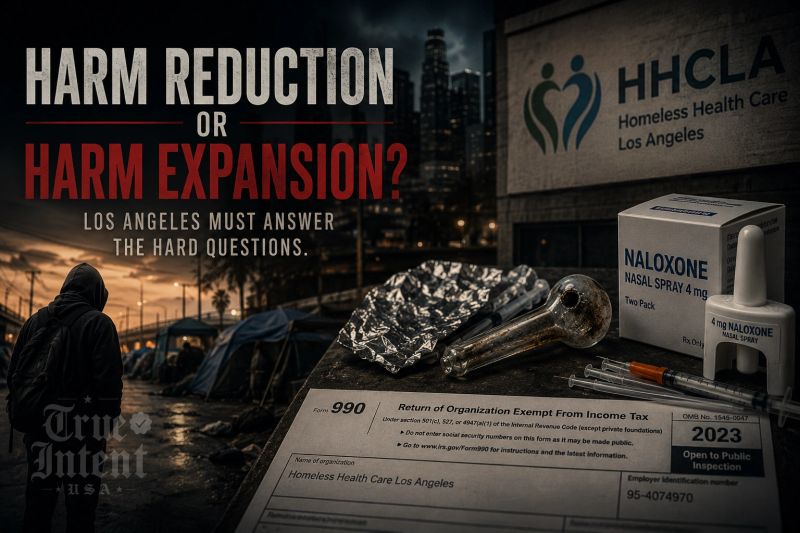
This article began after information was provided anonymously to our newsroom. Rather than repeat unverified allegations, we reviewed the publicly available IRS Form 990, Return of Organization Exempt From Income Tax, filed by Homeless Health Care Los Angeles for the fiscal year ending June 30, 2024.
The filing reports:
- $20,650,354 in total revenue.
- $19,147,721 in total expenses.
- $17,182,697 spent on program services.
- Approximately $19.6 million received through grants and contributions.
According to its own filing, Homeless Health Care Los Angeles provides behavioral health treatment, overdose prevention, medication-assisted treatment, syringe services, housing assistance, outreach, case management, and harm-reduction programs intended to reduce the health risks associated with substance use.
The filing also identifies Urban Alchemy as one of the organization’s highest-paid independent contractors, receiving approximately $1.33 million for professional services during the reporting year. The filing does not describe the specific services provided under that contract.
These are not accusations.
These are the organization’s own reported numbers.
But numbers alone do not answer the question many veterans are asking.
Where are the measurable outcomes?
If taxpayers invest more than $20 million into programs addressing addiction and homelessness, the public deserves to know:
- How many people completed treatment?
- How many achieved long-term sobriety?
- How many secured permanent housing?
- How many returned to work?
- How many veterans were served?
- How many veterans remained drug-free one year later?
- How many no longer required services because they successfully recovered?
If those outcomes exist, they should be celebrated.
If these programs are transforming lives, the evidence should be clear, measurable, and readily available to the public.
No one should fear transparency when public money is involved.
Veterans understand accountability.
In the military, success is measured.
Objectives are defined.
Performance is evaluated.
Results matter.
Publicly funded programs should be held to no lower standard.
Supporters of harm reduction argue these services prevent overdose deaths, reduce disease transmission, and create opportunities for future treatment. Those goals deserve serious consideration.
At the same time, many veterans ask whether reducing the dangers of addiction is enough if it is not consistently leading people toward recovery.
Compassion should never end with keeping someone alive for another day.
Compassion should also mean helping them build a life worth living.
Los Angeles taxpayers are investing millions of dollars every year into addressing one of the state’s greatest humanitarian crises.
The public deserves more than descriptions of services.
The public deserves evidence of results.
For veterans who have fought to reclaim their own lives after trauma, addiction, or homelessness, the question is simple:
Are these programs helping people recover… or merely helping them survive another day?
That is not a political question.
It is a moral one.
And it deserves an honest answer backed by measurable evidence.
Voices from Veterans
While reviewing the publicly available financial records, True Intent USA also spoke with a veteran who previously resided within the VA tiny homes community.
The veteran was careful to distinguish between what he personally witnessed and what he could not verify.
He stated that he never personally observed narcotics being exchanged and could not confirm many of the rumors circulating among residents. However, he described an environment where ambulances responded to the property with regular frequency and where concerns about illegal drug activity were common among residents.
He also shared concerns about the treatment of medically vulnerable veterans. According to his firsthand account, one diabetic resident was allegedly denied permission to keep a small refrigerator for insulin storage. He recalled that the resident was later evicted after protesting the policy and eventually became seriously ill, although he could not speak to what ultimately happened afterward.
These accounts represent the recollections of one former resident and should not be interpreted as proof of criminal conduct or institutional wrongdoing. They do, however, reinforce an important point:
Veterans are asking questions.
Questions about accountability.
Questions about safety.
Questions about whether the current system is producing recovery, or simply managing addiction and crisis.
Those questions deserve answers supported by facts, measurable outcomes, and transparency.
True Intent USA will continue seeking official records, public documents, and firsthand interviews to either corroborate or refute concerns raised by veterans. If the programs described are producing measurable recovery outcomes, those results deserve to be presented with the same transparency as the financial disclosures. Likewise, if deficiencies exist, veterans and taxpayers deserve an honest accounting of them.
Source
Internal Revenue Service. Form 990 – Return of Organization Exempt From Income Tax (Tax Year 2023; Fiscal Year Ending June 30, 2024), Homeless Health Care Los Angeles (EIN 95-4074970). Public disclosure filing.
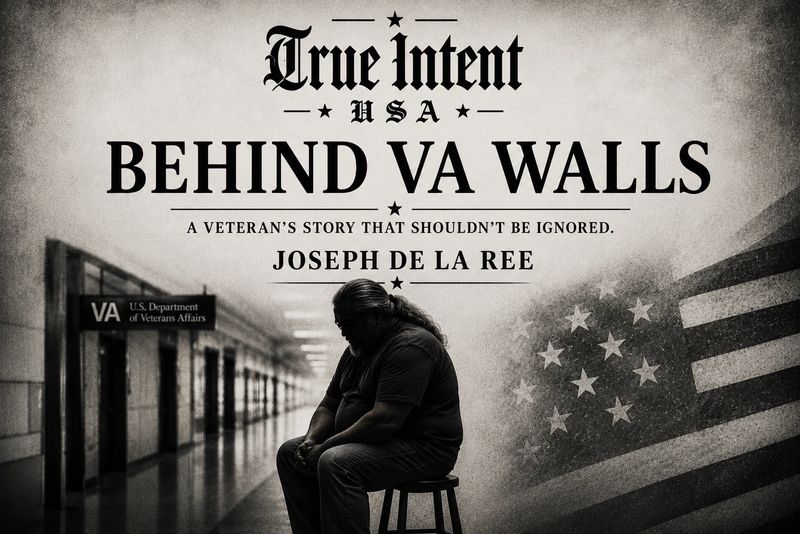
Joseph De La Ree
The Long Walk After Service
By True Intent USA
The first thing Joseph De La Ree wants people to understand is that stories like his are everywhere.
Not in headlines.
Not in speeches.
Not in campaign ads.
But in apartments veterans fought years to obtain.
In sober living homes.
On sidewalks surrounding the West Los Angeles VA campus.
Inside emergency rooms.
Inside silence.
“You don’t hear these stories,” he said during a long-form conversation recorded for You Are Home, a podcast produced through True Intent USA. “You’re not gonna hear this on the radio. You’re not gonna hear this on TV.”
For years, Joseph carried his story almost entirely alone.
It is a story about military service, addiction, untreated trauma, homelessness, survivor’s guilt, suicide attempts, and the long, uneven process of rebuilding a life after believing it was already over.
But before any of that happened, Joseph was simply a young man from Boyle Heights trying to escape the direction his life seemed headed.
Becoming A Marine
Joseph enlisted in the United States Marine Corps during the late 1980s after dropping out of East Los Angeles College and struggling to find stability.
At the time, he worked private security jobs in Little Tokyo and routinely walked miles home late at night because buses had stopped running.
Home life felt chaotic.
Directionless.
The Marines represented structure, purpose, and escape.
“I felt like a failure,” he recalled.
Joseph entered the Corps on an open contract without knowing exactly what job he would receive. During training at Marine Corps Recruit Depot San Diego, he suffered severe stress fractures in both legs but continued pushing through the pain.
Eventually he was assigned as an 0341 mortarman.
“Eighty-ones,” he said, laughing while remembering the identity Marines attached to the job. “That’s what they called us.”
The work was brutal.
Mortarmen routinely carried enormous amounts of weight during field operations: heavy packs, ammunition, baseplates, and mortar tubes over punishing terrain and long distances.
“You got a 45-pound pack on your back as is,” he said. “Then you either strap on your baseplate or your tube.”
The physical exhaustion became part of daily life.
So did the emotional culture surrounding it.
Joseph described a Marine Corps environment built on toughness, humiliation, dark humor, and survival. At times, he said, he also felt deeply isolated socially inside the Corps itself.
He recalled periods where rumors about his sexuality spread among other Marines, contributing to feelings of alienation and disconnection during service.
Meanwhile, the world outside was changing rapidly.
As tensions escalated in the Middle East during Operation Desert Shield, Joseph remembered confusion and frustration spreading through the ranks while Marines prepared for possible deployment.
At one point, he said Marines around him became angry after learning National Guard units had been activated ahead of some active-duty personnel.
“Why are they sending the Guard?” he remembered people asking.
Joseph spent time stationed in Okinawa and the Philippines during that era, often feeling trapped between uncertainty, military bureaucracy, and emotional isolation.
Then service ended.
And the structure holding his life together disappeared with it.
The Collapse After Service
After leaving the Marines, Joseph drifted.
He moved through temporary jobs, labor work, carnival crews, laundromats, and periods of instability while trying to suppress emotions he did not know how to process.
The discipline and identity the Corps once gave him slowly gave way to depression, addiction, and self-destruction.
Over time, methamphetamine and cocaine became part of everyday life.
Joseph described using drugs not only to escape emotional pain, but eventually to avoid sleep itself.
At one point during the 1990s, he attempted suicide by slashing his wrist with a skillsaw.
“I just wanted to die,” he said plainly.
He survived.
But surviving did not mean healing.
Years later, the emotional damage only deepened.
“I Froze.”
In 2018, Joseph’s fiancée died.
During the interview, he described the moment in painful detail, recalling how panic overtook him when she needed help.
“I should have ran out the fucking door,” he said. “I just froze.”
That moment became the emotional center of his life afterward.
He blamed himself relentlessly.
Sleep became difficult.
Then impossible.
He isolated himself from people around him while carrying what he repeatedly described as unbearable guilt.
Methamphetamine use intensified because staying awake felt easier than reliving the trauma alone at night.
Eventually Joseph found himself homeless around the West Los Angeles VA campus while battling severe PTSD, addiction, and suicidal thoughts.
He checked himself into psychiatric care hoping somebody would intervene before things became fatal.
Instead, according to Joseph, he felt processed rather than heard.
At one point in the interview, he described the experience this way:
“So basically, you go in there saying, ‘Hey, I’m suicidal. Can you help me?’ And they say, ‘We can’t help you because your records show you’re non-compliant taking your medications.’”
Then came the line that stayed with him:
“We hope you don’t kill yourself because that’s gonna go bad on us.”
Whether remembered word-for-word or through emotional recollection, the impact on Joseph was unmistakable.
He felt abandoned.
The Night Everything Broke
In January 2019, Joseph sat outside late at night holding a knife to his neck.
By then, grief, addiction, exhaustion, homelessness, and hopelessness had collapsed into one overwhelming moment.
He began stabbing and cutting repeatedly into his neck attempting to sever his carotid artery.
“Why the fuck can’t I die?” he remembered thinking.
A nearby friend eventually noticed what was happening and physically stopped him before he could continue.
Paramedics rushed Joseph to UCLA Medical Center where multiple surgical teams worked to save his life after massive blood loss.
He blacked out before reaching the emergency room.
When he woke up days later under suicide watch, he learned how close he had come to dying.
The physical wounds would heal faster than the emotional ones.
Rebuilding
Recovery happened slowly.
Joseph entered sober living programs in Long Beach focused on veterans struggling with addiction and mental health crises. For the first time in years, he found people willing to sit with him without judgment.
He met the woman who would later become his wife during this chapter of recovery.
Eventually, through the HUD-VASH housing program, Joseph secured permanent housing after years of instability and homelessness.
Today, he speaks openly about his past because he believes isolation is one of the most dangerous things a struggling veteran can experience.
Near the end of the interview, Joseph explained what he believes could have prevented his suicide attempt in the first place.
It was not politics.
Not slogans.
Not social media awareness campaigns.
It was human connection.
“If somebody would have come and talked to me and distracted me,” he said, “I probably never would have shanked myself.”
Then he clarified what kind of conversation he meant.
“Not the bullshit ‘Hey, how are you doing?’” he said. “The one where you’re ready to listen.”
Listening
Joseph’s story is difficult because it refuses easy categories.
It is not simply a story about heroism.
Or victimhood.
Or addiction.
Or mental illness.
It is a story about what happens when trauma compounds for years inside a person who slowly stops believing anyone would notice if he disappeared.
But it is also a story about survival.
About sober living.
About housing.
About rebuilding relationships.
About staying alive long enough to find purpose again.
Near the end of the conversation, Joseph offered one final message directed toward anyone worried about somebody they love.
“Don’t let your friends stay by themselves too long,” he said quietly. “That’s when thoughts creep up.”
Then he paused.
“Sometimes all it takes is saying hello.”
Published: May 16, 2026
Source Type: Anonymous Veteran Testimony
Compiled By: True Intent USA
BEHIND VA WALLS
Veteran Testimony Series • May 16, 2026
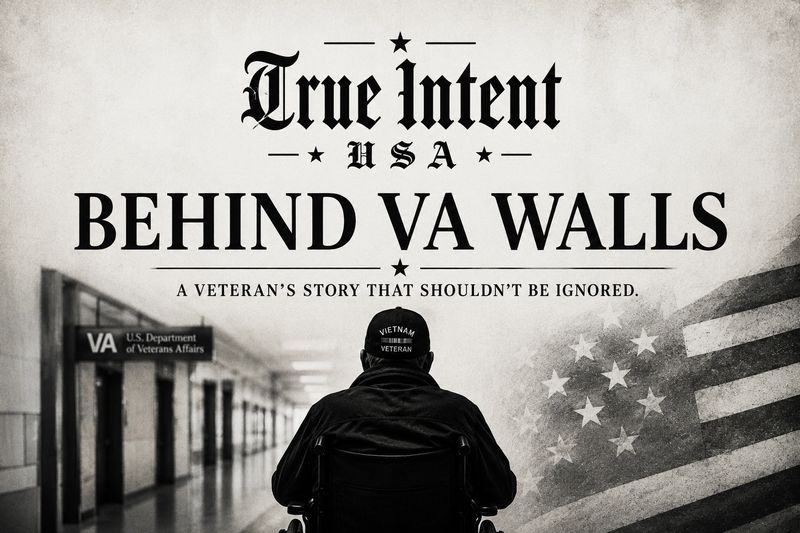
For many Americans, the words "veteran housing assistance" sound reassuring. They imagine stability, safety, and support waiting for those who served. But behind closed doors, some veterans describe a very different reality — one filled with confusion, instability, fear, and the feeling that nobody is listening.
This article documents the testimony of an anonymous 65-year-old disabled veteran connected to the West Los Angeles VA community. At his request, identifying information has been withheld.
According to the veteran, his original lease arrangement was disrupted after his disability approval process. He states that he later lost housing stability within the HUD-VASH system after refusing to provide additional money connected to a housing-related dispute.
The veteran alleges that nearly $2,000 was lost during the situation and says he requested a fraud investigation before agreeing to pay anything further. He states he had receipts and supporting documentation but felt ignored. What affected him most, however, was not only the financial hardship, but where he says he was placed. The veteran described being moved into housing in South Central Los Angeles — an environment he says immediately raised concerns due to visible gang graffiti and surrounding activity.
As a wheelchair-bound senior veteran, he recalls feeling vulnerable and deeply unsettled by the conditions surrounding him. The veteran also recalled an emotional conversation during a vehicle ride following one of the housing disputes. According to his account, the staff member involved became visibly upset and spoke about her own financial struggles as a single mother. The moment stayed with him and contributed to his belief that the situation surrounding his housing support had become deeply unstable and emotionally overwhelming.
In the end, what stayed with the veteran was not only the housing dispute itself, but the feeling that everyone involved seemed overwhelmed by systems larger than any one person. He recalled emotional conversations, financial confusion, fear about safety, and the growing sense that his life had become unstable while trying to navigate programs meant to help him. For him, the experience was never just about paperwork or housing placement — it was about dignity, trust, and the feeling of whether anyone truly cared what happened after his service ended.
True Intent USA is not publishing this testimony to attack individuals or sensationalize suffering.
The purpose of this article is to raise awareness about experiences some veterans say they face behind closed doors — experiences that often never reach mainstream media coverage.
Behind every statistic about homelessness, housing instability, and veteran care is a human being trying to hold onto dignity while navigating systems most civilians will never fully understand.
Some stories cannot be solved overnight. But they should still be heard.
"I was feeling so hopeless for a while."
True Intent USA
Honor. Dignity. Purpose.
Published: May 16, 2026
Source Type: Anonymous Veteran Testimony
Compiled By: True Intent USA
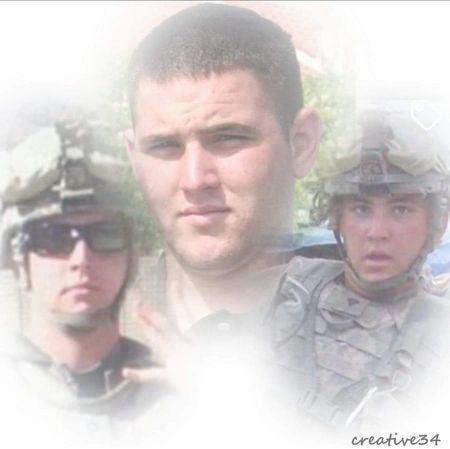
Jared Lynn Miller
US Army Veteran
Father • Son • Brother • Uncle
Jared Lynn Miller passed away on May 4, 2016, at just 28 years old. His story continues to raise difficult questions surrounding PTSD, homelessness, mental health treatment, and the realities many veterans face after service.
According to community testimony and reports shared over the years, Jared was arrested for jumping a turnstile and later ordered by a judge to receive PTSD-related treatment through the VA system before release. After being transported to the West Los Angeles VA campus, he was reportedly released back toward Skid Row with minimal support. Two days later, Jared was found dead.
For many veterans and advocates across Los Angeles, Jared’s story became symbolic of larger concerns involving gaps in care, untreated trauma, homelessness, and preventable loss among former service members.
This feature exists to honor Jared’s memory and preserve the conversations surrounding veterans who struggle silently after service.
Built to inform, not divide.
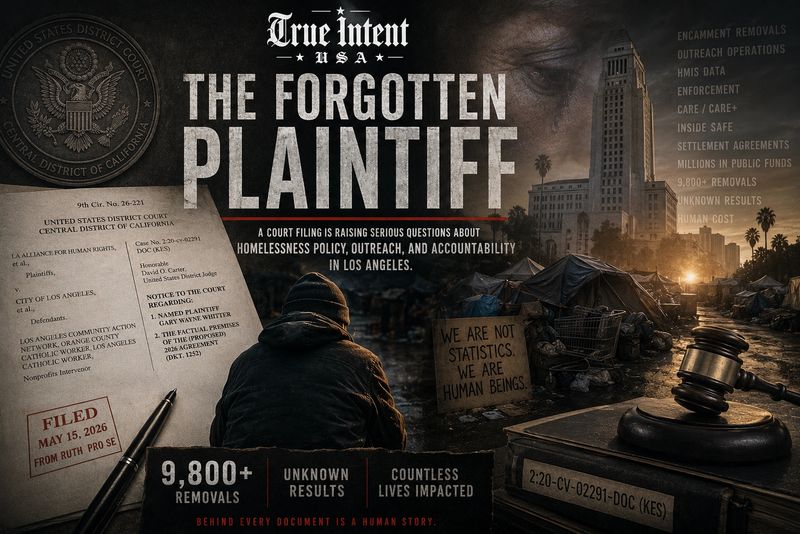
The Forgotten Plaintiff
A court filing tied to Los Angeles homelessness litigation raises new questions about outreach, enforcement, and the human cost of life on the streets.
Published May 20, 2026
By True Intent USA | The Record
For years, Los Angeles has struggled to answer one of the most difficult questions facing any major American city:
How do you address a homelessness crisis that is simultaneously humanitarian, political, legal, economic, and deeply personal?
Now, a newly filed notice in federal court is drawing renewed attention to the people caught inside that system — and to the growing distrust some unhoused residents say they feel toward the institutions claiming to help them.
The filing was submitted May 15 in the ongoing federal case involving LA Alliance for Human Rights, the City of Los Angeles, and several intervening organizations connected to homelessness advocacy and enforcement policy.
Authored by a self-represented unhoused individual identified in court records as “RUTH,” the filing alleges that outreach operations, data collection systems, and encampment removals are functioning in ways that many people living on the streets experience not as pathways toward housing, but as mechanisms of surveillance, displacement, and instability.
At the center of the filing is Gary Whitter, an unhoused man originally named as a plaintiff in the lawsuit.
According to the notice, Whitter’s legal claims were eventually dismissed after counsel withdrew representation. The filing further alleges that Whitter later died while still homeless in Los Angeles in 2025.
The notice questions why his name later appeared again within documents tied to the proposed 2026 agreement connected to the litigation.
The filing does not accuse the court itself of wrongdoing. Instead, it paints a broader picture of what the author describes as a homelessness response system increasingly driven by metrics, compliance structures, enforcement mechanisms, and public contracts — while many unhoused residents continue cycling through removals, instability, and deteriorating health conditions.
Among the strongest allegations contained within the notice are claims involving the use of Homeless Management Information System (HMIS) records.
According to the filing, outreach contacts allegedly generate records later used as evidence of compliance with housing-related obligations while simultaneously contributing to enforcement actions tied to encampment removals under Los Angeles Municipal Code § 41.18 and related city operations.
The filing also alleges that sweeps routinely result in the loss of medication, personal belongings, identification documents, hygiene supplies, and shelter materials for unhoused individuals already facing chronic medical and mental health challenges.
None of the allegations within the filing have been proven in court.
But the document arrives at a moment when frustration surrounding homelessness policy in Los Angeles continues to intensify from nearly every direction:
residents demanding safer streets,
business owners frustrated by encampments,
advocates criticizing enforcement tactics,
city officials under pressure,
and unhoused individuals describing systems they say often feel impossible to navigate.
For many Angelenos, the debate over homelessness has become centered on statistics:
bed counts,
housing targets,
budget allocations,
encampment numbers,
and compliance benchmarks.
The filing argues something different.
It argues that behind every spreadsheet, court order, outreach log, and enforcement operation are people whose lives cannot be reduced to administrative metrics alone.
The proposed 2026 agreement referenced in the filing involves significant policy and financial implications, including modifications to prior settlement obligations and additional public funding tied to ongoing compliance efforts.
The notice raises concerns about whether the systems intended to resolve homelessness are, in some cases, contributing to cycles of displacement that unhoused residents say leave them more vulnerable than before.
Los Angeles remains a city searching for answers.
But documents like this reveal something deeper beneath the legal language and policy debates:
a widening divide between institutional narratives about progress and the lived experiences of many people still surviving on the streets.
And for some advocates, that divide may now be impossible to ignore.
Sources & Court Records
United States District Court for the Central District of California
Case No. 2:20-cv-02291 DOC (KES)
Notice filed May 15, 2026 by “RUTH” pro se
STAY INFORMED.REAL STORIES. REAL OPERATIONS. REAL IMPACT.
Receive updates on veteran outreach operations, community missions, awareness campaigns, and stories from the field across Los Angeles.
Quick & Easy way to donate
Complete your donation securely in just a few clicks.