
How it works
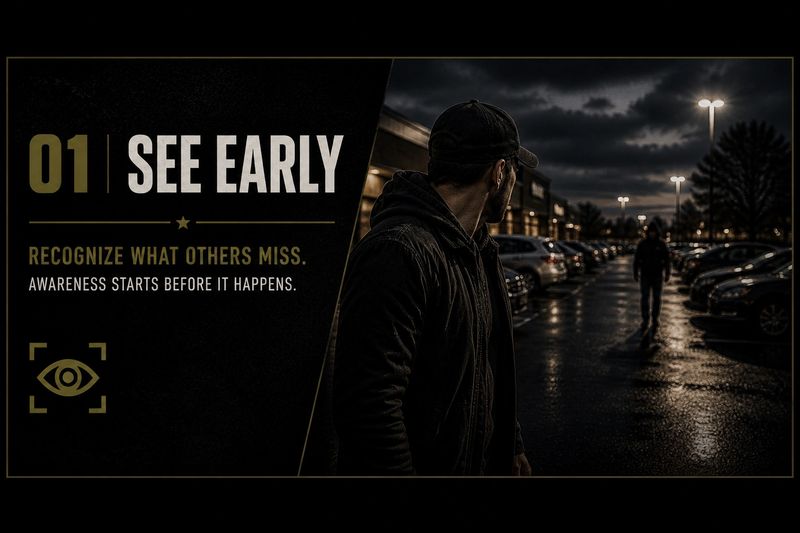
How we train this
Participants are taught how to recognize their environment before anything happens.
Training begins by breaking down what awareness actually looks like in real-world settings. Instructors guide participants through how to keep their attention forward, identify entry and exit points, and observe movement around them without distraction.
Using real-life scenarios such as parking lots and public walkways, participants are shown how to scan their surroundings, notice changes in behavior, and identify potential risks early—before they develop into problems.
This step focuses on building simple, repeatable habits:
- Keeping your head up and attention off your phone
- Identifying exits, blind spots, and high-risk areas
- Noticing movement, distance, and unusual behavior
Participants are then guided through these scenarios and asked to identify what stands out, helping them develop the ability to recognize what others often miss.
Awareness starts before it happens.
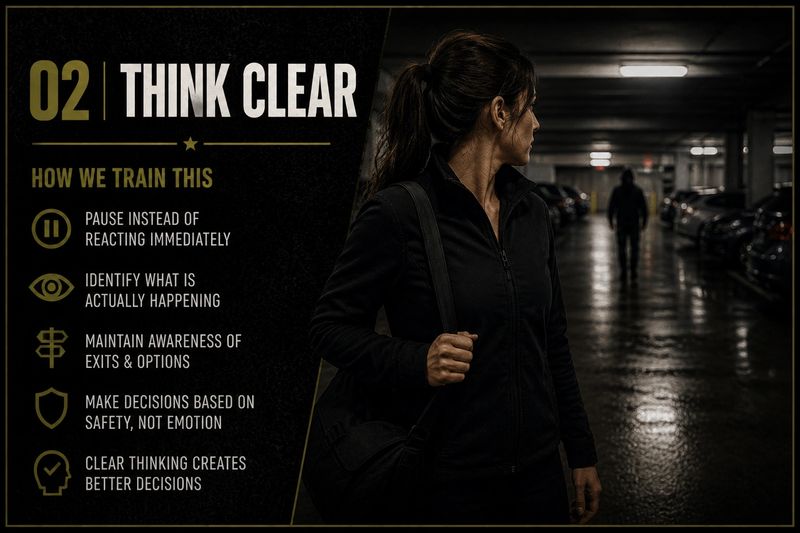
How we train this
Participants are trained to stay calm, process information, and make clear decisions under pressure.
After learning how to recognize their surroundings, participants are guided through what happens next—how to think in the moment without panic or hesitation. Instructors break down how stress affects decision-making and how to maintain control when something feels off.
Using real-world scenarios, participants are walked through situations where they must pause, assess, and choose the safest course of action. Emphasis is placed on slowing down their response, observing details, and avoiding rushed or emotional reactions.
This step focuses on building mental clarity through simple, repeatable actions:
- Pausing instead of reacting immediately
- Identifying what is actually happening vs. assumed
- Maintaining awareness of exits and options
- Making decisions based on safety, not emotion
Participants are guided through these moments and asked what they would do and why—helping them build confidence in their ability to think clearly before taking action.
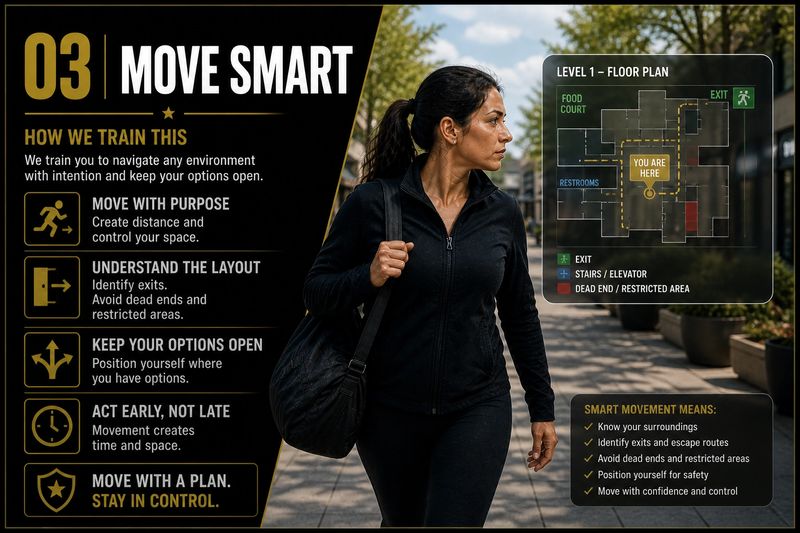
How we train this
Participants are trained to move through environments with intention, awareness of layout, and control of their options.
Instructors teach how to quickly understand the structure of a space, identifying exits, pathways, and areas that limit movement such as corners, narrow walkways, or dead ends. Participants learn to recognize where they are positioned and how that affects their ability to respond if needed.
Through guided scenarios, participants are shown how to reposition themselves, create distance, and move toward safer, more open areas before a situation develops. Emphasis is placed on avoiding confined spaces and maintaining access to exits at all times.
This step focuses on building practical movement habits:
- Understanding layouts in real time
- Identifying exits and escape routes
- Avoiding dead ends and restricted areas
- Positioning yourself where you have options
- Moving early to create time and space
Participants are guided through these decisions so they leave with a clear understanding of how to move with purpose—not react without direction.
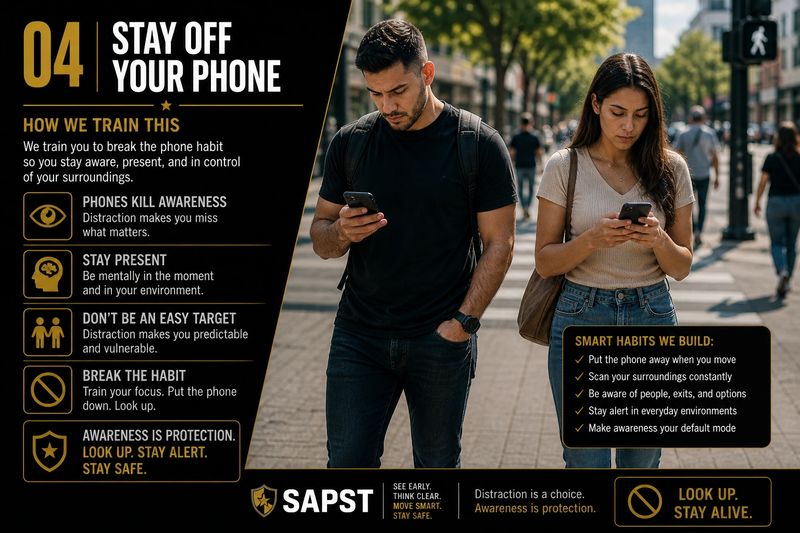
STAY PRESENT
How We Train This
Participants are trained to recognize how distraction—especially from cell phones—reduces awareness and limits their ability to respond to their environment.
Instructors demonstrate how quickly attention is lost when focus is placed on a screen. Through guided scenarios, participants experience the difference between moving while distracted and moving while fully aware.
Training focuses on simple behavioral adjustments:
- When to put the phone away
- How to stay aware while moving through public spaces
- How to quickly re-engage with surroundings after distraction
- Maintaining visual awareness of people, movement, and exits
Participants are coached to build awareness as a habit, not a reaction, so their attention remains on their environment rather than their device.
How They Train Themselves
Participants are encouraged to apply this daily using simple, repeatable habits:
- Put the phone away while moving
Walking, parking lots, and entrances require full attention - Look up every few seconds
Break the habit of constant screen focus - Scan your environment regularly
People, exits, movement, and changes - Pause before using your phone in public
Ask: Is this the right moment to disconnect? - Make awareness your default
Not something you turn on—something you stay in
support the cause
all funds directly help the at risk community